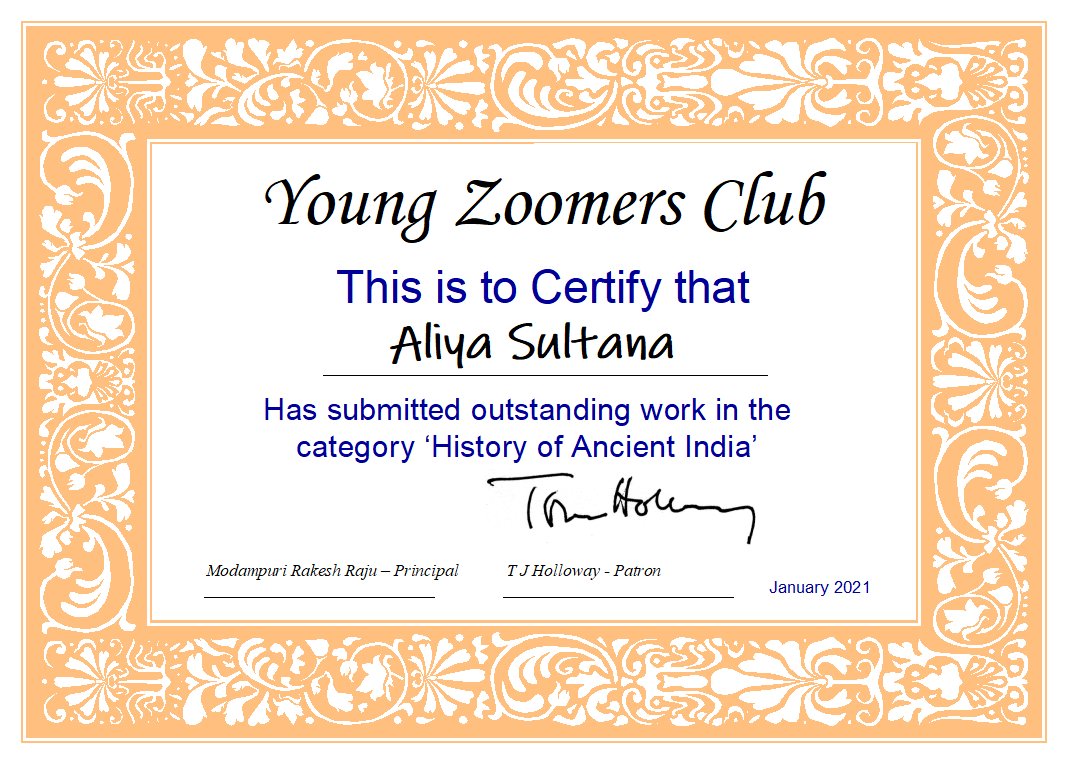
I completed my schooling from IDPL High School in 2020. currently I'm pursuing eleventh standard in 'Sri Gayatri Junior Collage', Hyderabad.
My hobbies are listening to songs and singing, reading books and travelling far away. My goal is to become an Airhostess.
I thank my school for giving me lots of memories I also thank my school teachers, who taught us moral values and ethics. That moment when we finally leave our school will be most memorable and worth memory and I would like to thank my volunteer teacher Rakesh sir, for conducting private online classes for us.
Last but not least I would also like to show my gratitude towards Tom Holloway, an IBM Computer Consultant in Oxford, who runs online classes through zoom.


The Indus Valley Civilisation
The Indus Valley was home to one of the world's first large civilizations. It began nearly 5000 years ago in an area of modern-day Pakistan and northern India. The civilization was first identified in 1921 at Harappa in the Punjab region and then in 1922 at Mohenjo-daro, near the Indus river in the Sindh region both sides are in Pakistan, in punjab and sindh provinces,respectively. The ruins of Mohenjo-daro were designated a UNESCO world heritage site in 1980.
The Harappan civilization was located in the Indus river valley. Two large cities, Harappa and Mohenjo-daro, were located in present-day Pakistan's Punjab and Sindh provinces, respectively.
There were more than 1,400 towns and cities in the indus valley. The biggest were Harappa and Mohenjo-daro. Around 80,000 people lived in these cities.
The first farmers
liked living near the river because it kept the land green and fertile
for growing crops. These farmers lived together in villages which grew
over time into large ancient cities, like Harappa and Mohenjo - Daro.
The Indus people needed river water to drink, wash and to irrigate their
fields. Agriculture was the main occupation of Indus Valley people.
The two biggest cities of indus valley civilization were Mohenjo –
Daro and Harappa people lived in stone houses that were 2 – 3 stories
high and all of them had a sewage system.
The system was built
with mud bricks and ran under the street the city of Mohenjo – Daro
which had 3,500 people and they had about 700 wells which brought underground
water to the surface, and the upper and lower sides of the city Mohenjo
– Daro were not joined but they were close together.
The upper side was built out of mud with large buildings and also the
great bath. The lower side of the city had small houses that were all
similar.
The ancient drains
are in a side street in the city of Mohenjo – Daro. The drain in
the centre street is joined with smaller drains from each house.
Regular floods destroyed the area and Aryan invaders killed people and
destroyed the Indus Valley civilization. Thus it took hundred of years
again for India to have beautiful cities like Mohenja - Daro and Harappa.
The end was partly caused by changing river patterns.